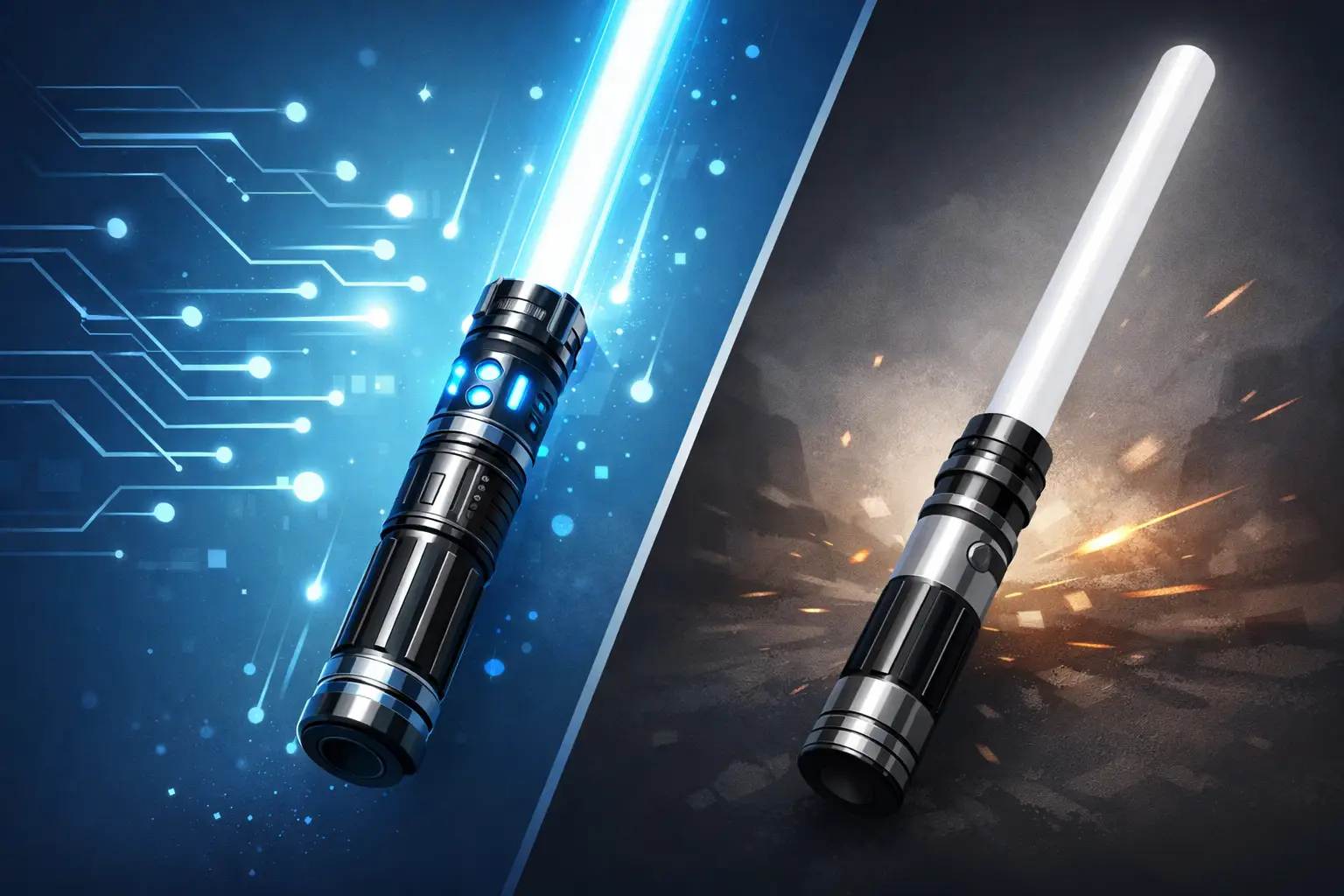
The choice between electronic versus stunt sabers becomes real the moment you picture how the saber will be used. Will it light up a darkened hallway during a cosplay reveal? Hang proudly on a wall? Survive regular backyard duels with friends? The right answer is less about which saber is “better” and more about whether you want cinematic immersion, straightforward durability, or a smart balance of both.
For a first-time Padawan, the feature list can feel intimidating. For an experienced Sith or Grey Jedi, it can be tempting to chase every upgrade. Start with the use case. A saber that feels perfect in your hand and supports the way you actually play, train, display, or perform is the one you will keep reaching for.
Electronic Versus Stunt Sabers: The Core Difference
An electronic saber is built to create a more immersive experience. Depending on its configuration, it may offer ignition and clash sounds, motion effects, multiple blade colors, blaster effects, music, flash-on-clash, gesture controls, and programmable sound fonts. Higher-end electronic setups can produce a bright, animated blade effect that looks especially impressive in photos, video, and dim rooms.
A stunt saber puts the focus somewhere else: the physical build. Traditionally, it uses a simpler lighting setup with fewer electronics, little or no sound, and a durable blade designed for training and recreational contact. Many duelists appreciate the reduced complexity. There is less to configure, less to charge, and fewer internal components to consider when the saber is taking repeated hits.
The terms are useful, but they are not always absolute. Some modern combat-ready sabers include sound and effects while still being suitable for responsible dueling. Likewise, some simple illuminated sabers are sold as entry-level models rather than dedicated stunt builds. Always check the blade type, hilt construction, and the seller’s intended-use guidance rather than choosing from the name alone.
Choose an Electronic Saber for the Full Experience
Electronic sabers are for fans who want the moment. A satisfying ignition sound, responsive swing audio, and a blade that reacts when it meets another saber can turn a costume, convention walk-through, or living-room duel into something far more memorable.
They are often the best fit for collectors who want a display piece with personality. Character-inspired hilts, detailed Jedi designs, and aggressive Sith styling gain another layer of presence when the blade hums and the color matches the owner’s chosen path. For cosplay, a feature-rich saber gives performers more ways to make an entrance and creates better visual payoff in low-light photos.
Electronic options also make great gifts when the recipient values Star Wars-inspired immersion over hard sparring. A Youngling seeing a saber ignite for the first time does not need a complex training weapon. They want the glow, the sound, and the feeling that it is theirs.
There are trade-offs. More electronics usually mean a higher price, more settings to learn, and a battery that needs occasional charging. Pixel-style blades can create spectacular effects, but their electronics are housed in the blade itself. That makes them better suited to display, cosplay, and light contact than repeated heavy dueling. If your plan is to practice strikes several nights a week, choose a setup specifically rated for that purpose.
Best electronic saber uses
Electronic sabers make the most sense for cosplay, collecting, gifts, choreography, content creation, and fans who want sound and color customization. They are also a strong choice for anyone who sees the saber as a personal fandom piece first and a training tool second.
Choose a Stunt Saber for Training and Dueling
A stunt saber earns its place through simplicity. With a sturdy hilt, a combat-ready blade, and fewer sensitive features competing for space inside, it is made for the fan who wants to swing without overthinking menus or effects.
For regular recreational dueling, that simplicity can be a real advantage. A durable blade and dependable internal setup matter more than a dozen sound fonts when you are working through drills, practicing choreography, or meeting friends for controlled combat. Stunt-focused sabers are also often easier to hand to a new duelist. The experience is immediate: grip, activate, train.
They can be an especially practical match for families. Parents shopping for Padawans may prefer a simpler model for supervised play because it keeps the focus on handling and safety. A basic setup can also be less stressful if a saber gets dropped, bumped, or used more enthusiastically than intended.
That does not mean stunt sabers are boring. A clean, bright blade and a well-balanced hilt still deliver the essential saber feeling. Many serious duelists eventually keep both styles: an electronic saber for events and display, plus a tougher stunt build for practice.
What “combat-ready” should mean
No saber is indestructible, and no product description should suggest otherwise. Responsible dueling means using an appropriate blade, keeping strikes controlled, avoiding the electronics and emitter area, and inspecting the saber after hard sessions. Contact can loosen parts over time, particularly if the hilt uses removable couplers, retention screws, or interchangeable components.
A combat-ready saber should be chosen with the same care you would give other recreational gear. Look for a secure blade retention system, a hilt that feels stable in your grip, and a blade suited to the intensity of your use. If you expect frequent contact, it is wise to prioritize durability and balance over the most elaborate effects.
Blade Type Matters as Much as the Hilt
The electronic versus stunt saber decision is often really a blade decision. The hilt may look nearly identical from the outside, but the blade technology changes how the saber performs.
A baselit blade is illuminated from the hilt. It is generally a practical choice for active use because the blade itself does not contain a long strip of LEDs. It may not create the same scrolling ignition or localized impact effects as a pixel blade, but it can offer a bright, reliable look with a more duel-friendly design.
A pixel blade contains LEDs along its length. That is what allows for vivid scrolling effects, unstable blade styles, localized blaster flashes, and dramatic flash-on-clash. It is the choice for fans who want screen-inspired visual flair. The trade-off is that replacing or repairing a pixel blade can cost more, and it deserves more care during contact.
Blade length matters, too. A shorter blade can feel easier for a younger fan, close-quarters choreography, or a compact hilt. A longer blade gives a more traditional silhouette and reach, though it can feel less manageable for smaller users. The best length is the one you can control comfortably, not necessarily the longest option available.
Match the Saber to Your Path and Budget
A thoughtful purchase starts by putting your main purpose first. If you are buying for a Youngling or a new Padawan, an accessible starter saber with a manageable blade and simple controls is usually the right call. It creates an exciting first experience without making setup feel like homework.
For a Jedi-minded collector, an electronic saber with refined hilt details, sound, and customizable colors can feel like a long-term display piece. Grey Jedi fans may want the middle ground: a practical, balanced saber that can look sharp on display but still come outside for occasional sparring. Sith buyers often prioritize an intimidating hilt profile, a vivid red blade, and audio that gives every ignition real presence.
Budget belongs in the conversation, but it should not be the only deciding factor. Spending more on electronics you will never use is not always a win. On the other hand, buying a basic saber for someone whose dream is dramatic effects can leave them wanting an upgrade sooner than expected. Think about where the saber will spend most of its time: in motion, on display, at a convention, or in a gift box waiting for its first ignition.
Before ordering, confirm what is included. Blade, charger, batteries, tools, and setup instructions can vary by configuration. It also helps to buy from a retailer that clearly stands behind the product. SaberBros personally inspects sabers before shipment and backs purchases with warranty protection, free U.S. shipping, and real support when a question comes up after the package arrives.
A Better Question Than “Which One Wins?”
Electronic and stunt sabers are not rivals in the way fans sometimes make them out to be. One is designed to heighten the fantasy. The other is designed to keep up with the action. Plenty of saber owners eventually decide they want both, because a dark-room ignition and a confident training session ask different things from a hilt.
Choose the saber that fits the story you want to create with it. If you want every swing, clash, and color change to feel cinematic, lean electronic. If you want a dependable partner for practice and controlled dueling, lean stunt. And if you are still torn, start with the moments you most want to have after the saber arrives - that answer usually points you in the right direction.